


Article — 4 Min Read
History of a Winged Form in Art
Article — 4 Min Read
History of a Winged Form in Art

From its origins in ancient myth to its enduring presence in Western visual culture, Pegasus embodies a set of ideas — poetic inspiration, transcendence, and the tension between earthly constraint and celestial ascent — that have continuously invited reinterpretation across centuries.
MYTHIC ORIGINS
FROM HESIOD TO VISUAL FORM
Pegasus enters the literary canon through Hesiod and later Ovid, where he emerges from the blood of Medusa after her beheading by Perseus. Quickly associated with the hero Bellerophon, Pegasus becomes both a vehicle of conquest and a symbol of divine favor.
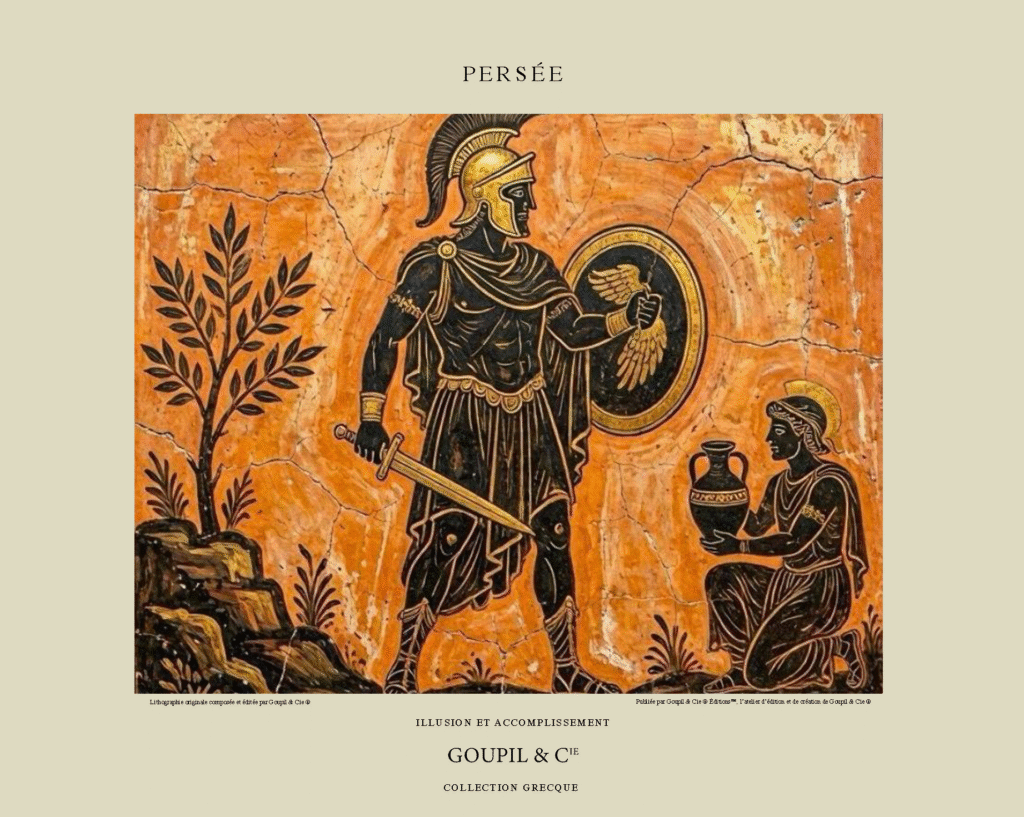
Persée, Illusion et accomplissement, lithographic edition — Greek Collection. © 2026 Goupil & Cie. All rights reserved.
In early Greek art, particularly on black-figure and red-figure vases, Pegasus appears in profile — compact, stylized, and integrated into narrative scenes. These representations emphasize legibility over dynamism, establishing the iconographic foundations of the figure.
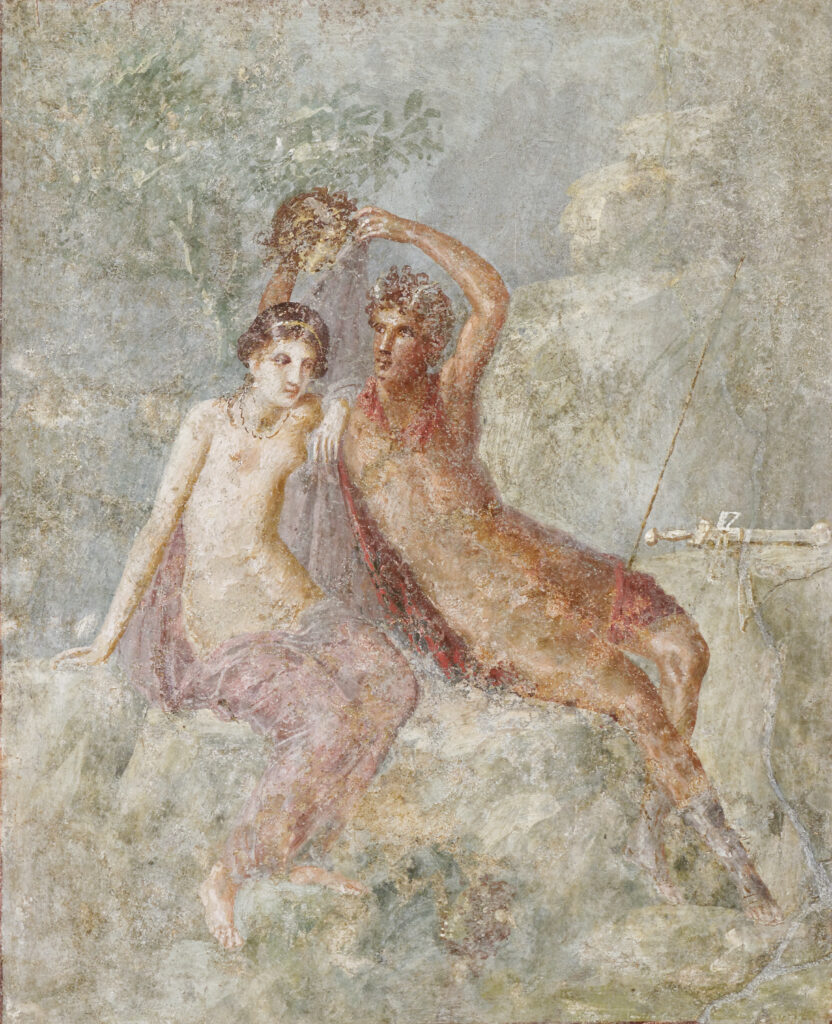
Perseus and Andromeda, 1st century AD Fresco from the Casa della Saffo, Insula Occidentalis (Regio VI), Pompeii
CLASSICAL AND HELLENISTIC FORMULATIONS
BETWEEN MONUMENT AND MOTION
In Classical antiquity, Pegasus acquires greater anatomical clarity and sculptural presence. Though few large-scale sculptures survive, reliefs and coins attest to a growing interest in the creature’s dual nature: grounded in equine realism, yet defined by the addition of wings.
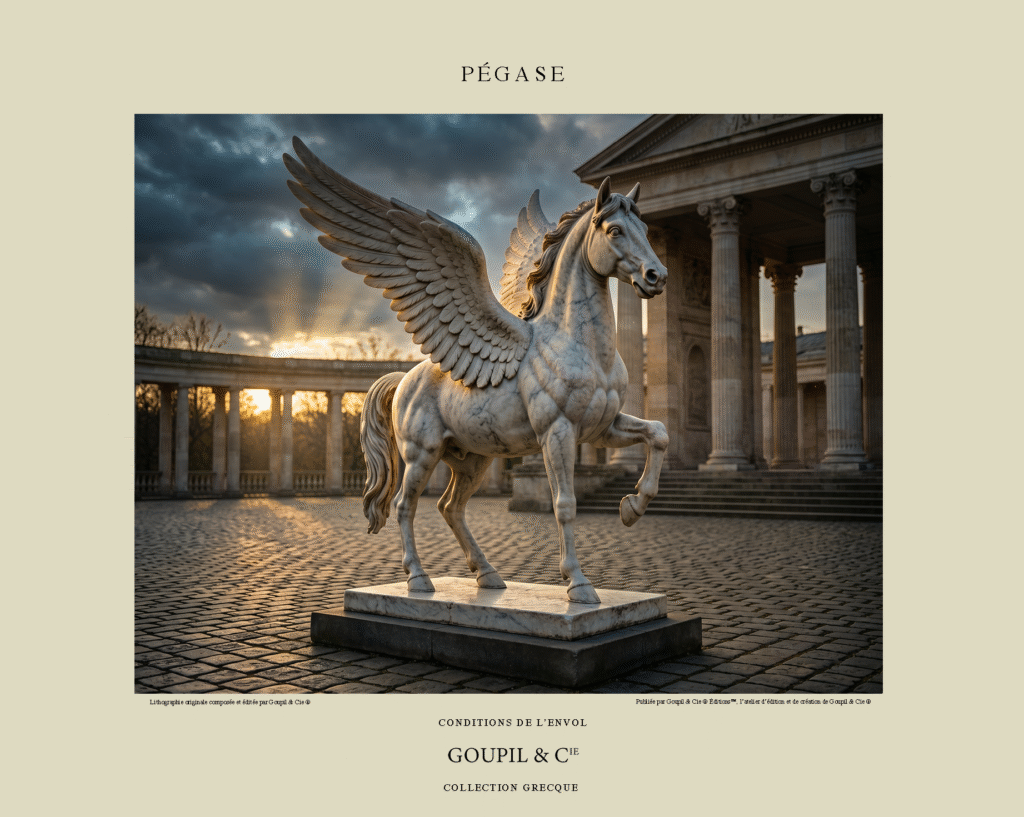
Pégase, Conditions de l’envol, lithographic edition — Greek Collection. © 2026 Goupil & Cie. All rights reserved.
The challenge is formal as much as symbolic — how to render flight within the constraints of material. Pegasus thus becomes an early site of experimentation in representing suspended movement.
This tension gives rise to a refined visual strategy in which motion is suggested rather than fully enacted. Wings are often held in poised extension, bodies articulated in controlled dynamism, as if the moment of ascent were indefinitely deferred. In Hellenistic interpretations, this latent energy becomes more pronounced: musculature tightens, contours sharpen, and the figure appears caught between impulse and restraint. Pegasus is calibrated, its form negotiating the limits of gravity, matter, and representation, and in doing so, establishing a lasting paradigm for the visualization of the airborne.
RENAISSANCE REINTERPRETATIONS
HUMANISM AND THE RETURN OF MYTH
With the revival of classical antiquity, Pegasus re-emerges in Renaissance art as a vehicle for intellectual and poetic allegory. In works such as “Pallas and the Centaur” (c. 1482) by Sandro Botticelli, the broader mythological framework to which Pegasus belongs is reactivated, even when the creature itself is absent — its symbolic associations circulating within a larger Neoplatonic system.
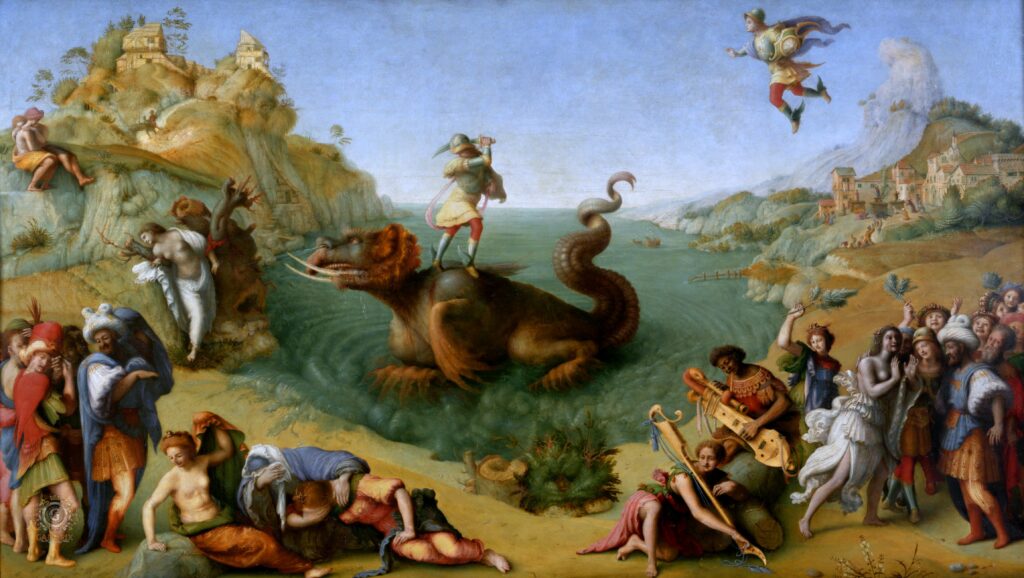
Piero Di Cosimo (c. 1462-1522), Perseus Freeing Andromeda, c. 1510–1513.
More directly, Pegasus appears in “Perseus Freeing Andromeda” (c. 1510–1515) by Piero di Cosimo, where the winged horse is rendered with a delicate balance between observation and imagination. Here, Pegasus is no longer purely narrative; it becomes an exploration of grace, motion, and the poetic potential of myth.
BAROQUE DYNAMICS AND DRAMATIC ASCENT
MOVEMENT INTENSIFIED
The Baroque period amplifies Pegasus’s inherent dynamism. In “Perseus and Andromeda” (1622) by Peter Paul Rubens, the creature participates in a composition defined by swirling movement and heightened emotion. Wings extend, bodies twist, and the scene becomes a theater of ascent and rescue.
Pegasus here is no longer a secondary element; it is integral to the composition’s energy, embodying the Baroque fascination with motion, transformation, and spectacle.
NEOCLASSICAL AND MODERN REVISIONS
FROM EMBLEM TO ABSTRACTION
In the 18th and 19th centuries, Pegasus is reinterpreted through the lens of Neoclassicism and Romanticism. Artists such as Jean-Auguste-Dominique Ingres and Gustave Moreau engage with mythological subjects in ways that emphasize line, clarity, and symbolic resonance. In Moreau’s work in particular, Pegasus becomes an oneiric figure — less anatomical than visionary.
By the modern period, the figure undergoes further transformation. In “Pegasus” (1940s) by Odilon Redon (and related works), the winged horse dissolves into atmosphere and color, becoming less a creature than a state of mind.
Across these transformations, Pegasus resists fixation. It is at once narrative and abstract, physical and symbolic. Each period redefines its function: from mythological actor to allegorical vehicle, from anatomical challenge to poetic sign. Pegasus endures precisely because it cannot be fully contained within any single representation. In the history of art, Pegasus is less a motif than a question: how to give form to ascent, how to render the invisible impulse toward elevation. And it is in the repeated attempt to answer this question that its image continues to evolve.
Get updates about our next sales and exhibitions
We will process the personal data you have supplied in accordance with our privacy policy.